
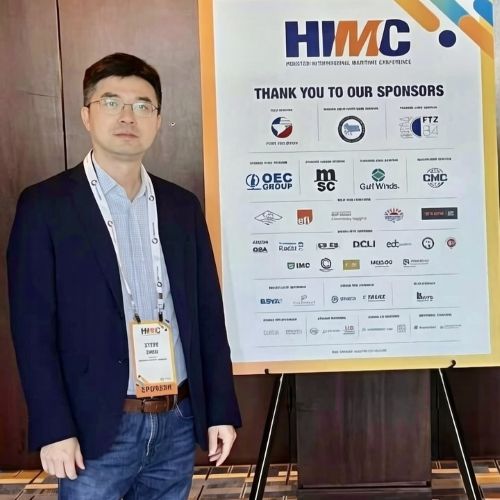
Dr. Steve Zhou is the Chair of UHD’s Department of General Business, Marketing and Supply Chain Management and serves as the PLM Endowed Professor and Professor of Supply Chain Management and Business Intelligence.
When Dr. Steve Zhou entered the field of supply chain management more than two decades ago, his focus was on helping businesses grapple with a fundamental challenge: how to move products and manage resources more efficiently. At the time, globalization was stretching supply chains across countries and continents, increasing the distance among manufacturers, suppliers, and customers.
“Robots cannot replace humans,” Zhou said. “Human connection is essential in these interactions.”
That dynamic becomes particularly visible in professions like customer service, where chatbots now handle many interactions traditionally handled by a person over the phone.
For Zhou, the challenge is not choosing between people and AI, but determining how each can contribute to a better outcome. AI can process information and generate responses, but understanding what a customer actually needs may still require human judgment and emotional intelligence.
“How do we combine human and artificial intelligence?” Zhou said.
But determining how people and AI work together is only part of the challenge. Zhou is also examining the ethical concerns surrounding the growing amounts of data collected.
From cameras on roads and buildings to technology inside vehicles, Zhou pointed to how much information is collected throughout everyday life. “Businesses can use data to make better decisions and generate value, but we also have to ask how that data can be used ethically while protecting people’s privacy,” he said.
Zhou explained that responsible AI use means finding ways to benefit from the information available without losing sight of the people who generated it. The goal is to create value while protecting individuals as businesses determine how AI fits into their operations.
Another part of his work is focused on preparing the next generation of business professionals. The university has expanded its Business Intelligence offerings with a new BBA, a graduate certificate, and an MBA with a Business Intelligence certificate.
From generative AI and data and text mining to visual analytics and storytelling, Gators are learning to use technology while developing the human skills needed to interpret what it produces and communicate those findings to others. His MBA students report that they use the knowledge and skills from his courses at work, in quality control, process improvement, and optimizing contracts with chartered-vehicle suppliers, with notable financial results for their organizations.
“We train students to ask the right questions. The bottom line of the BI program is to create excellent storytellers in the AI age,” Zhou said.
That approach reflects the evolution of Zhou’s research. Two studies published this year explore digital coupon strategies and outsourced customer acquisition and retention, while his current work increasingly examines how artificial intelligence can work alongside human intelligence.
Zhou believes the same balance should guide how AI is used in education. Rather than replacing the thinking behind learning, he sees the technology as a tool students should actively direct, evaluate, and learn alongside.
His message as the technology continues to evolve is to embrace its possibilities without losing sight of the human responsibility that comes with them.
“Be open-minded and embrace it, but also be cautious and use it responsibly,” Zhou said.